 Home
Home
Grease Trap and Interceptor Cleaning for RI and MA Restaurants and Food Service Operations.
Professional Grease Trap Cleaning in Rhode Island and Massachusetts
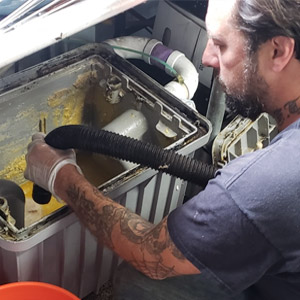
A grease trap is not optional equipment for a food service operation, and cleaning it is not optional maintenance. In Rhode Island and Massachusetts, grease trap cleaning is a regulatory requirement enforced by the Narragansett Bay Commission, the Massachusetts Water Resources Authority, and local boards of health across every city and town in the region. The frequency, the documentation, and the disposal method are all specified by regulation. The consequences of non-compliance range from fines and enforcement notices to forced closure during a health inspection.
Wood's Rooter provides professional grease trap and interceptor cleaning for restaurants, cafes, hotels, commercial kitchens, schools, food processing operations, and any other food service establishment connected to the municipal sewer system in Rhode Island and Southern Massachusetts. We pump, clean, and dispose of grease trap waste on a compliant schedule, provide a service manifest for every visit, and offer ongoing maintenance programs so you never have to track cleaning intervals or scramble before an inspection.
If you are currently managing your grease trap cleaning schedule on your own, or if you are not sure when your trap was last professionally serviced, call us. We will assess the trap, give you a straight answer about its current condition, and recommend the right service interval for your volume of kitchen output.
Grease Trap and Interceptor Cleaning FAQs
The answer depends on three factors: your trap's size and type, the volume of FOG your kitchen produces, and the regulatory requirements that apply to your specific jurisdiction.
As a practical baseline: indoor point-of-use traps in high-volume commercial kitchens typically require monthly cleaning. Outdoor in-ground grease interceptors require cleaning at a minimum of every 90 days for most food service operations in Providence and the surrounding area, per NBC requirements, and at minimum every three months per MWRA standards in Massachusetts.
Both states apply the 25% rule, which means cleaning is required when the combined FOG and solids depth reaches 25% of the trap's total liquid depth, regardless of the calendar interval. If your kitchen volume is high relative to your trap size, you may reach that threshold before the 90-day minimum, in which case the cleaning must happen sooner. We can assess your trap and recommend the right interval for your operation.
The 25% rule is the regulatory threshold used by the NBC in Rhode Island and the MWRA in Massachusetts to determine when a grease trap must be cleaned.
It states that cleaning is required when the combined depth of floating FOG at the top of the trap and settled solids at the bottom reaches 25% of the trap's total liquid depth. At that point, the effective separation zone inside the trap is too small for the trap to function correctly, and FOG begins bypassing the outlet baffle and entering the sewer system.
Health inspectors and environmental regulators can measure trap contents against this threshold during inspections. If your trap is at or above 25%, you are out of compliance regardless of when it was last cleaned.
In both Rhode Island and Massachusetts, grease trap service records must be kept on-site and available for inspection for a minimum of three years.
The required documentation includes the date of each cleaning, the volume of waste removed, and the name and license information of the hauler who performed the service. In Massachusetts, septage haulers are additionally required to file a System Pumping Record with the relevant regulatory agency within 14 days of service.
Wood's Rooter provides a completed service manifest for every cleaning visit that satisfies these documentation requirements. Keep the manifest on file from each visit and your three-year compliance record builds itself.
The Narragansett Bay Commission (NBC) is the regional wastewater authority serving a significant portion of Rhode Island, including Providence, Cranston, Johnston, North Providence, and surrounding communities.
The NBC Grease Control Program requires food preparation facilities connected to the NBC sewer system to obtain a wastewater permit and comply with FOG management standards, including regular grease trap cleaning and documentation.
If your food service establishment is in an NBC service area, the Grease Control Program almost certainly applies to you. If you are unsure, the NBC website lists its service area and permit requirements, or call us and we can advise based on your address.
A grease trap is typically a smaller unit, ranging from a few gallons to several hundred gallons of capacity, installed inside the building near the kitchen fixtures it serves, often under a prep sink or behind the dishwasher.
A grease interceptor is a larger, outdoor in-ground system installed underground between the building's plumbing and the municipal sewer connection, typically with capacity measured in thousands of gallons. Both serve the same purpose: intercepting FOG before it enters the sewer.
Interceptors have much greater capacity and typically require less frequent cleaning than indoor traps, though the 25% rule and regulatory minimums apply to both. Wood's Rooter services both indoor grease traps and outdoor grease interceptors of all sizes.
No. In both Rhode Island and Massachusetts, using chemical or biological agents to dissolve FOG and release it into the sewer system is explicitly prohibited and constitutes illegal dumping, subject to fines and enforcement action.
Chemical products marketed as grease trap treatments that work by liquefying grease so it passes through the trap defeat the purpose of the trap entirely: they simply move the FOG into the sewer rather than removing it from the wastewater stream. The only compliant method of grease trap cleaning is mechanical removal by a licensed hauler, with the waste transported to an approved disposal facility.
Biological maintenance products like Grease-X Biozyme, applied between professional cleaning visits to reduce FOG accumulation in drain lines, are a different category and do not replace professional pumping. They supplement it.
The consequences depend on the severity of the violation and the regulatory authority involved. Common outcomes of a grease trap compliance failure include a written notice of violation requiring remediation within a specified timeframe, an administrative fine, a requirement to demonstrate compliance with documentation before resuming operations, a sewer surcharge for excess FOG discharge, and in severe cases involving ongoing non-compliance or environmental impact, enforcement action including temporary closure.
The fastest path to resolving a violation notice is professional cleaning with proper documentation, combined with establishing a compliant ongoing maintenance program. If you have received a notice of violation related to your grease trap, call us immediately. We will assess the trap, clean it, and provide the documentation you need to respond to the notice.
We provide a completed service manifest for every cleaning visit. The manifest documents the date of service, the volume of waste removed, and our licensing information as the hauler. This is the document that constitutes your cleaning record under NBC, MWRA, and local Board of Health record-keeping requirements.
Keep it on file from each visit. After three years of service, you will have a complete documented maintenance history for the facility that demonstrates continuous compliance. We do not leave without providing this documentation.
Grease trap cleaning removes the accumulated FOG and solids from the trap itself. The kitchen drain lines leading from your fixtures to the trap also accumulate FOG and the biofilm that forms as FOG decomposes. Persistent odor after a trap cleaning typically originates in these drain lines rather than the trap itself.
Hydro-jetting of the kitchen drain lines clears the line walls of accumulated grease and the decomposing organic material that produces the smell. Grease-X Biodeodorizer applied to floor drains and sink drains between cleanings digests odor-causing organic material at the source and provides ongoing odor control.
If your kitchen has persistent drain odor despite a recently cleaned grease trap, a combination of drain line jetting and Biodeodorizer treatment is likely the solution. Call us and we will advise on what makes sense for your specific situation.
Yes. We understand that kitchen operations run on tight schedules and that grease trap service during a dinner rush or peak service period is not workable. We coordinate service timing around your operating schedule.
Early morning before kitchen prep, after closing, or on a scheduled off-day are all times we can accommodate. When you call to set up service, tell us what your operating hours are and we will schedule around them.
Yes, and we recommend them for any food service operation with a regular compliance obligation. A recurring maintenance program means your cleaning schedule is set in advance based on your trap size, kitchen volume, and regulatory requirements. You receive a service manifest for every visit, building your compliance documentation automatically. You have a consistent contact for all service coordination. And you are not in the position of trying to remember when you last had the trap cleaned or rushing to schedule service when an inspection is coming. Call us to discuss what a program would look like for your operation.
We will ask about your trap configuration, your kitchen volume, and your jurisdiction's requirements, and we will build a schedule that keeps you compliant without requiring you to manage it yourself.
This depends on your lease terms and the specific configuration of the grease trap infrastructure. In some cases, the grease trap is part of the building's shared plumbing infrastructure and the property owner bears responsibility for its maintenance. In others, the lease places responsibility on the food service tenant.
Regardless of the lease arrangement, if the property has a non-compliant grease trap, regulatory enforcement can extend to the property owner as well as the tenant.
We work with property managers and landlords to assess grease trap infrastructure, establish the right service program for the facility, and coordinate directly with food service tenants on scheduling. Call us to discuss your property's specific situation.